

Most money laundering doesn't announce itself with flashing lights and cartoonishly suspicious behaviour — it hides quietly among the ordinary.
A customer who's strangely evasive during onboarding, or a dormant account that suddenly springs to life and starts moving funds across high-risk jurisdictions. On their own, these moments can feel small, forgettable even. Together, they can tell a very different story.
That's the challenge facing modern compliance teams. Common AML red flags rarely arrive neatly packaged as obvious criminal activity. They're fragmented, messy, and buried beneath staggering volumes of customer data, transactions, adverse media, and cross-border financial activity.
Meanwhile, money launderers are becoming increasingly sophisticated — layering transactions, hiding behind shell companies, exploiting high-risk jurisdictions, and moving funds through digital assets and complex ownership structures designed to blur the trail.
For banks, fintechs, crypto platforms, and other regulated businesses, spotting suspicious activity is less about spotting one suspicious transaction and more about understanding context:
In this guide, we'll break down the most common AML red flags businesses should watch for, where they tend to appear, and how AI-powered investigations are helping compliance teams surface hidden risk faster, reduce false positives, and investigate financial crime with far greater depth and confidence.
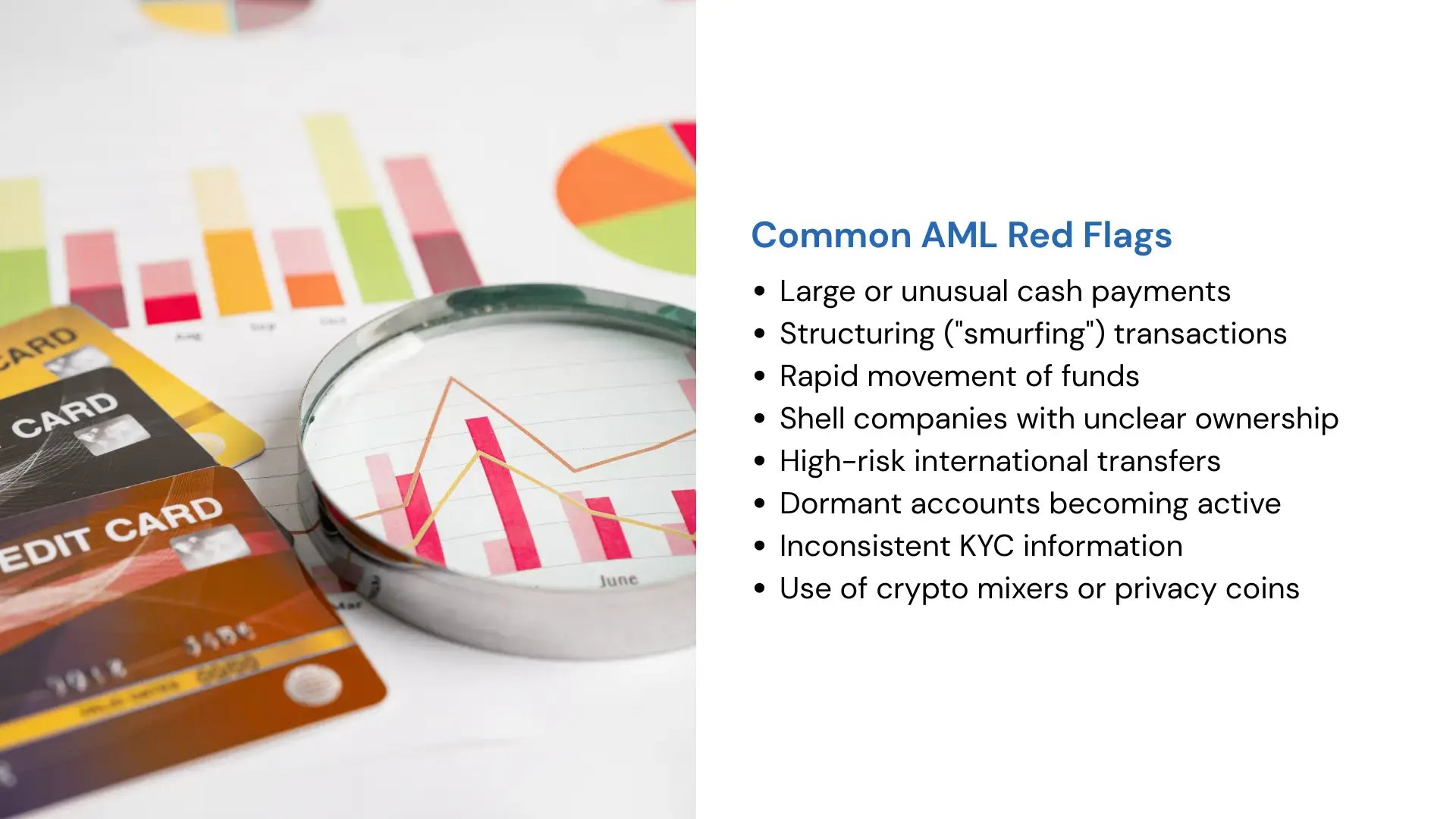
Common AML red flags span cash, structuring, fund velocity, ownership and crypto activity.
What Are AML Red Flags?
Under UK Money Laundering Regulations, Financial Action Task Force (FATF) guidance, and wider global AML frameworks, AML red flags are warning signs that may indicate money laundering, terrorist financing, fraud, or other financial crimes.
They're the subtle inconsistencies investigators and compliance teams are trained to spot — where a transaction, customer, or business activity doesn't line up with what's expected.
More often than not, AML red flags are frustratingly ambiguous. A transaction may appear legitimate in isolation. The risk only becomes visible when investigators zoom out and examine the wider context surrounding the customer, their relationships, their account behaviour, and the movement of funds over time.
That's why modern anti-money laundering investigations rely heavily on pattern recognition, contextual intelligence, and risk-based analysis rather than rigid box-ticking exercises.
Financial institutions are expected to assess whether customer behaviour aligns with their known profile, business activities, geographic exposure, and expected financial activity. When something feels inconsistent, unusually complex, or deliberately opaque, it can signal a need for deeper investigation.
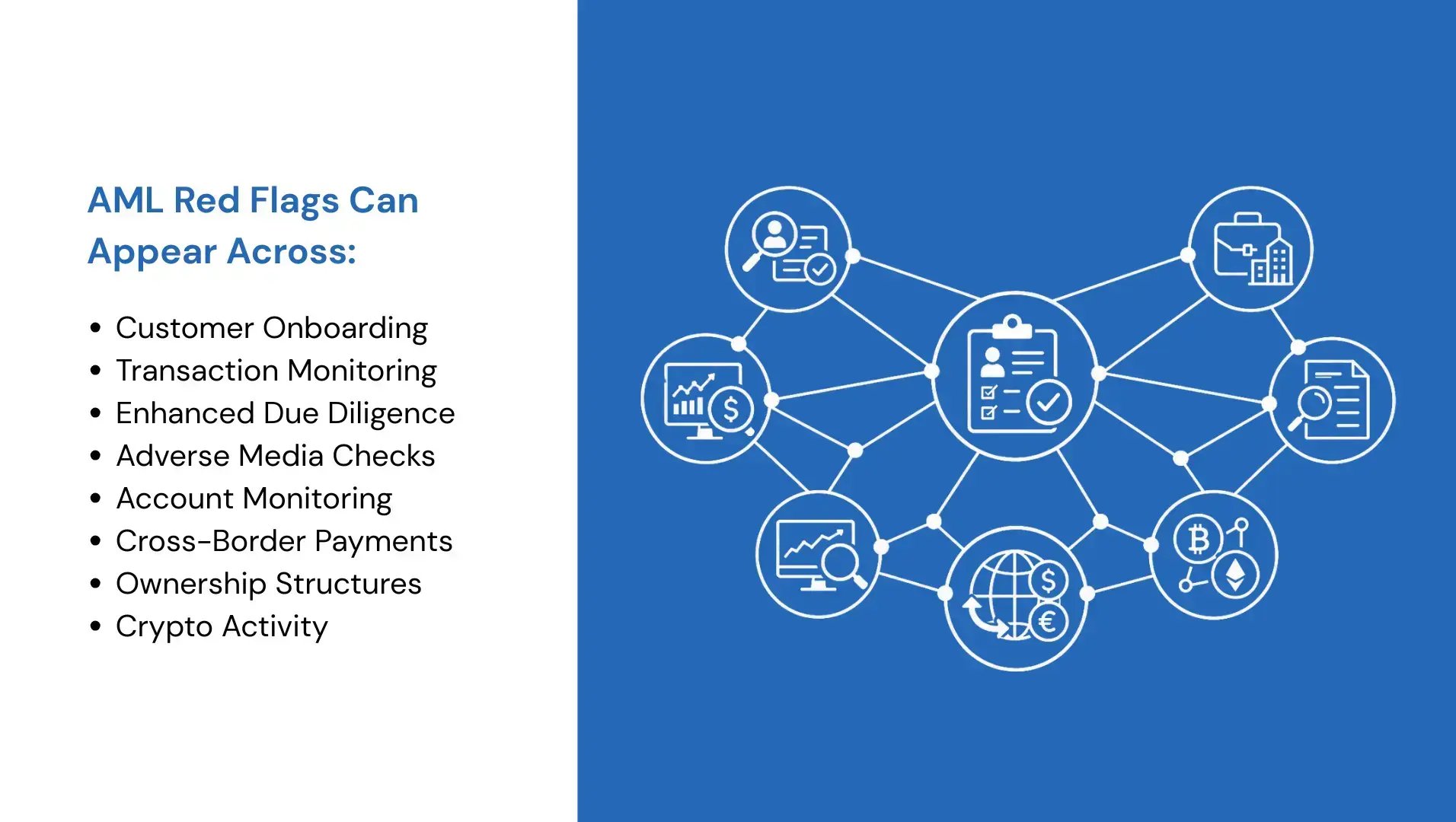
AML red flags can appear at virtually every stage of the customer lifecycle.
It's important to note that a red flag is not proof of criminal activity. Many legitimate customers may trigger isolated warning signs for entirely innocent reasons. The role of AML investigations is to determine whether those inconsistencies reflect genuine risk or simply unusual — but explainable — behaviour.
Why AML Red Flags Matter
Most financial crime investigations don't begin with definitive proof. AML red flags matter because they're often the earliest visible clues that something much larger is unfolding beneath the surface.
For financial organisations, missing those signals can have serious consequences. Money laundering isn't just a compliance headache; it fuels organised crime, corruption, sanctions evasion, terrorist financing, human trafficking, cybercrime, and fraud on a global scale.
Guidance from the Financial Action Task Force (FATF) and national authorities makes it clear that firms must identify, investigate, and respond to warning signs before illicit activity escalates. Failure to do so can result in staggering financial penalties, reputational damage, regulatory scrutiny, and, in severe cases, criminal liability.
The businesses that detect financial crime effectively are rarely the ones with the most alerts. They're the ones best equipped to identify the patterns that actually matter, hidden amongst thousands of ordinary transactions.
Common AML Transaction Red Flags
Transactional AML red flags are often the first indicators that something deeper may be wrong. Certain transaction patterns can suggest attempts to disguise the origins of illicit funds, avoid reporting thresholds, or move money in ways that don't align with a customer's expected behaviour or business activity.
Below are some of the most common warning signs compliance teams should watch for.
Structuring & Smurfing
Structuring, sometimes referred to as smurfing, involves breaking large transactions into multiple smaller payments to avoid triggering reporting thresholds or attracting regulatory scrutiny. This can include repeated cash deposits made just below reporting limits, or funds spread across multiple accounts to make activity appear less suspicious.
Unusually Large Cash Transactions
Large cash payments remain one of the clearest AML red flags, particularly when they fall outside a customer's normal financial activity. Excessive use of cash can also suggest attempts to avoid traceability.
Rapid Movement of Funds
Moving money rapidly between accounts, jurisdictions, or financial institutions with little obvious business purpose can indicate layering activity — a common money laundering technique used to obscure the source of funds before they are reintegrated into the financial system.
Round-Dollar Transactions
Frequent round-dollar transactions, particularly high-value transfers involving unusually clean figures, can sometimes suggest fabricated invoices, artificial payment activity, or attempts to move illicit funds in a more controlled, less conspicuous way.
Transactions With No Clear Business Purpose
Transactions that lack an obvious commercial rationale are a major warning sign. This might include payments between unrelated entities, unexplained transfers to foreign accounts, or financial activity that doesn't align with the customer's stated business operations.
High-Volume International Transfers
Frequent international transactions involving multiple jurisdictions — especially high-risk countries or regions with weak AML controls — can suggest attempts to move funds through complex cross-border networks designed to obscure ownership and transaction trails.
Dormant Accounts Becoming Active
An account that has shown little or no activity for an extended period before suddenly processing large transactions, international transfers, or rapid cash movements may warrant further investigation.
Sudden Changes in Transaction Behaviour
Sharp changes in spending habits, transaction frequency, account usage, or payment destinations can indicate elevated AML risk, particularly when the activity no longer aligns with the customer's historical behaviour or known financial profile.
Customer AML Red Flags
Not all AML risks appear in transaction data. In many cases, the strongest warning signs come from customer behaviour, onboarding inconsistencies, or attempts to avoid scrutiny altogether. Customers involved in possible money laundering often try to create confusion, limit transparency, or distance themselves from the true financial assets.
Reluctance to Provide KYC Information
Customers who resist providing identity documents, information about their source of funds, or basic Know Your Customer (KYC) details can present a significant AML risk. Avoidant onboarding behaviour is often one of the earliest warning signs compliance teams encounter.
Inconsistent Customer Information
Conflicting addresses, mismatched account details, inconsistent employment information, or discrepancies between documents and stated business activity can indicate attempts to conceal identity or misrepresent financial activity.
Use of Nominees or Third Parties
Transactions conducted through intermediaries, third parties, or individuals with no obvious connection to the account could suggest attempts to obscure beneficial ownership or distance the true parties involved from the movement of funds.
Complex Ownership Structures
Layered corporate entities, offshore vehicles, and unusually complicated arrangements are common AML red flags, particularly when identifying the ultimate beneficial owner becomes unnecessarily difficult.
Politically Exposed Persons (PEPs)
Politically Exposed Persons (PEPs), along with their close associates and family members, are considered higher risk due to their potential exposure to corruption, bribery, and abuse of public position. Financial institutions are typically expected to apply Enhanced Due Diligence measures when dealing with PEPs, as outlined in UK AML regulations and HMRC guidance.
Customers Operating in High-Risk Jurisdictions
Customers with strong financial ties to high-risk countries, secrecy jurisdictions, or regions with weak AML controls may require enhanced monitoring, particularly where transaction activity appears inconsistent or unusually complex.
Shell Companies With Limited Transparency
Shell companies with minimal operational presence, vague business activities, no clear online footprint, or opaque ownership structures are frequently used to move and disguise illicit funds. While not inherently illegal, limited transparency should trigger closer scrutiny.
Business & Corporate AML Red Flags
Corporate structures can provide legitimate commercial advantages, but they can also be used to conceal ownership, move illegitimate funds, and create distance between criminal activity and the individuals behind it. For AML teams, the challenge is identifying when a business structure crosses from complex into deliberately opaque.
Unclear Source of Funds
Businesses unable or unwilling to clearly explain where funds originated should raise immediate concern. This is particularly relevant in high-value transactions, private funding arrangements, or cases involving large unexplained payments with little supporting documentation.
Businesses With No Online Presence
A company claiming significant revenue or international operations but leaving virtually no digital footprint can be a major warning sign. Limited public information, inactive websites, or the absence of credible business activity may indicate a shell entity rather than a genuine operating business.
Unusual Company Structures
Excessively layered entities, offshore holding companies, or complicated ownership arrangements spanning multiple jurisdictions can suggest attempts to obscure beneficial ownership or make financial activity harder to trace.
High-Risk Industries
Certain sectors naturally carry elevated AML risk due to high cash volumes, cross-border activity, or historically weak oversight. This can include industries involving precious metals, luxury goods, gambling, virtual assets, money services businesses, and international trade.
Frequent Changes in Ownership or Directors
Repeated changes to company directors, shareholders, beneficial owners, or registered business addresses without a clear commercial explanation can indicate instability, concealment tactics, or attempts to avoid regulatory attention.
Transactions That Do Not Match Business Activity
When transaction behaviour doesn't align with a company's stated operations, compliance teams should investigate further. For example, a small domestic business suddenly processing large international transfers or high-volume foreign exchange transactions may indicate possible money laundering activity.
AML Red Flags in Crypto & Digital Payments
Crypto and digital payment platforms have created faster, more accessible financial ecosystems — but they've also introduced new opportunities for fraudsters to launder funds quickly, anonymously, and across borders with limited friction. For compliance teams, identifying suspicious crypto activity often requires looking beyond individual transactions and scrutinising the wider flow of funds.
Use of Mixing or Tumbling Services
Crypto mixing and tumbling services are designed to obscure transaction trails by blending digital assets from multiple users together. While some users seek privacy for legitimate reasons, these services are frequently associated with money laundering, sanctions evasion, and illicit movement of funds.
Transactions Involving High-Risk Wallets
Transfers involving wallets linked to darknet marketplaces, sanctioned entities, fraud schemes, or known criminal networks should trigger immediate scrutiny. Exposure to high-risk wallet addresses can significantly elevate AML risk.
Rapid Crypto-to-Fiat Conversions
Customers rapidly converting large volumes of cryptocurrency into fiat currency without a clear economic rationale may be attempting to legitimise funds, particularly where transaction behaviour appears inconsistent with their financial profile.
Cross-Chain Transaction Obfuscation
Also known as chain hopping, this involves moving assets rapidly across multiple blockchains, platforms, or decentralised exchanges. It can be used to complicate tracing efforts and fragment transaction visibility, making the source and destination of funds harder to identify.
Use of Privacy Coins
Privacy-focused cryptocurrencies designed to conceal wallet balances, identities, and transaction histories can present heightened AML challenges, particularly when combined with high transaction velocity or transfers involving high-risk jurisdictions.
Trade-Based Money Laundering Red Flags
Trade-Based Money Laundering (TBML) involves disguising illicit funds through seemingly legitimate trade transactions. Because global trade naturally involves complex supply chains, international payments, and fluctuating valuations, suspicious activity can be surprisingly difficult to spot without deeper investigation.
Over- or Under-Invoicing
Deliberately inflating or undervaluing goods or invoices is a common TBML tactic. Manipulated pricing allows criminals to move value across borders while making transactions appear commercially legitimate on paper.
Phantom Shipments
Transactions involving goods that never actually existed or were never shipped can indicate attempts to justify the movement of illicit funds through fabricated trade activity and false documentation.
Multiple Invoices for the Same Goods
Duplicate invoicing allows the same shipment or product to be paid for multiple times, creating opportunities to move additional funds under the guise of legitimate business transactions.
Unusual Shipping Routes
Goods routed through multiple countries without a clear logistical or commercial reason may indicate attempts to complicate transaction trails or involve jurisdictions with weaker AML oversight.
Mismatch Between Goods & Customer Profile
Trade activity that doesn't align with a customer's known business operations, industry, or financial profile should raise concern. For example, a small technology company suddenly importing high volumes of precious metals would likely warrant closer scrutiny.
Behavioural AML Red Flags
Sometimes the clearest AML warning signs have nothing to do with transaction data at all. Behaviour can be incredibly revealing, particularly when customers become evasive, defensive, or unusually anxious during onboarding, due diligence checks, or routine account reviews.
Evasive or Defensive Behaviour
Customers who avoid straightforward questions, provide vague answers, or become disproportionately defensive when asked about their financial activity, source of funds, or business relationships may warrant additional scrutiny.
Urgent Requests to Process Transactions
Attempts to pressure staff into processing transactions unusually quickly — particularly high-value or cross-border payments — can indicate efforts to bypass normal compliance controls or deeper review.
Attempts to Avoid Reporting Thresholds
Customers who appear overly familiar with reporting requirements, or deliberately structure transactions to remain below monitoring thresholds, may be attempting to avoid triggering AML controls.
Frequent Account Changes
Repeatedly opening, closing, or switching accounts without a clear explanation could suggest attempts to disrupt monitoring visibility or fragment financial activity across multiple institutions.
Reluctance to Explain Transactions
Customers unwilling or unable to provide a reasonable explanation for unusual payments, complex transaction activity, or relationships with third parties present elevated financial crime risk, particularly when multiple warning signs appear together.
How AML Teams Investigate Red Flags
Spotting an AML red flag is only the beginning. The real work starts when compliance teams need to determine whether suspicious activity has a legitimate explanation or points to something far more serious. Effective AML investigations rely on context, corroboration, and the ability to connect fragmented pieces of information.
Risk-Based Investigations
Most AML teams use a risk-based approach to prioritise investigations based on factors such as customer profile, transaction behaviour, geographic exposure, and potential financial crime risk. Higher-risk cases typically receive deeper scrutiny and enhanced monitoring.
Enhanced Due Diligence (EDD)
Enhanced Due Diligence goes beyond standard KYC checks and involves gathering additional intelligence on customers, beneficial owners, source of wealth, business relationships, and transaction activity. EDD is commonly applied to high-risk customers, PEPs, and complex corporate structures — but it can also be triggered when red flags are identified during standard Customer Due Diligence (CDD).

Adverse Media Screening
Adverse media checks, sometimes referred to as negative news screening, help investigators identify links to fraud, corruption, sanctions, organised crime, or other negative reporting across publicly available media — such as news sources, watchlists, and government records. Because risk exposure can change quickly, adverse media monitoring is often an ongoing process rather than a one-off check.
Ongoing Monitoring & Alert Reviews
AML investigations don't stop after onboarding. Compliance teams continuously monitor account activity, unusual transactions, and behavioural changes to identify emerging risks that may require escalation.
Suspicious Activity Reports (SARs)
Where financial crime concerns cannot be reasonably resolved, businesses may need to file a Suspicious Activity Report (SAR) with relevant national authorities. SARs formally notify regulators, and law enforcement investigates potential money laundering and wider criminal activity.
The Challenges of Detecting AML Red Flags
Identifying suspicious activity sounds straightforward in theory. In reality, modern AML investigations are often slowed by fragmented data, overwhelming volumes of alerts, and sophisticated criminal tactics designed to blend into ordinary financial behaviour.
High False Positive Rates
Many AML monitoring systems generate extremely high false positive rates, with some industry estimates placing them above 90%. This can create significant alert fatigue for compliance teams and make genuinely suspicious activity harder to spot quickly.
Fragmented Customer Data
Customer intelligence is often scattered across disconnected systems, databases, spreadsheets, and external sources. Investigators can end up spending more time gathering information than actually assessing risk.
Evolving Financial Crime Typologies
Money laundering methods evolve constantly. Criminal networks regularly adapt their tactics, using shell companies, digital assets, cross-border transactions, and increasingly complex ownership structures to avoid detection.
Manual Investigation Bottlenecks
Many AML investigations still rely heavily on manual research, repetitive data collection, and time-consuming documentation reviews. As transaction volumes grow, these workflows become increasingly difficult to scale effectively.
Regulatory Pressure
Regulators expect firms to demonstrate strong AML controls, robust risk assessments, and clear investigative processes. At the same time, compliance teams are under pressure to investigate faster, reduce false negatives, and maintain consistent decision-making across large volumes of alerts.
How AI is Improving AML Red Flag Detection
Traditional AML systems are struggling to keep pace with modern financial crime. Criminal networks are moving funds faster, hiding behind complex ownership structures, and generating enormous transaction volumes designed to overwhelm compliance teams. As a result, many firms are turning to AI to help prevent money laundering and terrorist financing.
AI-Powered Transaction Monitoring
AI-powered monitoring systems can analyse huge volumes of transaction data in real time, helping identify unusual behaviour patterns that may indicate money laundering, structuring, layering, or other suspicious activity that traditional rule-based systems may miss.
The same research found that 43% of respondents believe AI will significantly enhance fraud detection, prevention, and AML efforts — a reflection of growing pressure on compliance teams to investigate faster and more accurately.
Automated Risk Scoring
Rather than relying solely on customer risk profiles, AI models can assess AML red flags using transaction behaviour, geographic exposure, adverse media, account activity, and customer relationships — without relying just on manual review. This allows compliance teams to prioritise genuinely higher-risk cases and reduce time spent reviewing low-risk alerts.
Entity Resolution & Network Analysis
AI can help investigators uncover hidden relationships between individuals, businesses, multiple bank accounts, and transactions by connecting fragmented data across multiple systems and sources. It involves techniques such as deduplication, where duplicate records are consolidated to create a unified view of the entity. This makes it easier to identify shell companies, hidden beneficial owners, and suspicious financial networks that may otherwise remain buried beneath disconnected datasets.
AI for Enhanced Due Diligence
Enhanced Due Diligence is often one of the most manual and laborious parts of an AML investigation. Analysts may need to review corporate records, sanctions lists, adverse media, ownership structures, and public data sources just to build a complete picture of a client's identity.
This is where DeepDive supports investigators. By combining multilingual search, NLP-driven source analysis, entity resolution, and AI-powered knowledge reports, DeepDive helps investigators uncover hidden risk indicators, reduce false positives, and build deeper contextual intelligence.
Real-Time Monitoring & Alert Prioritisation
AI is also helping compliance teams move from reactive monitoring towards more proactive risk detection. Instead of relying purely on static rules and thresholds, AI systems can continuously assess evolving customer behaviour and prioritise alerts based on situational risk.
For overwhelmed AML teams dealing with growing investigative backlogs, that efficiency gain can make a substantial difference.